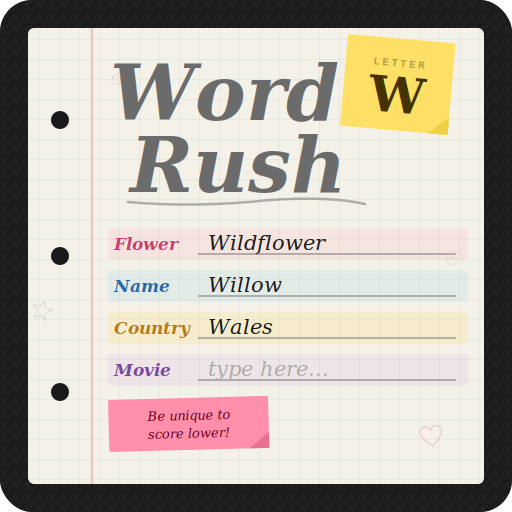
Word Rush
A competitive word game inspired by Wordle and Stop, built entirely on AWS serverless infrastructure.
The Concept
Word Rush takes the daily-challenge format popularized by Wordle and mixes it with the competitive spirit of Stop (the party game where you race to name things by category). Each round presents players with a category and a starting letter. Your goal: pick the most unique word possible. The less common your answer, the lower your score — and in Word Rush, the lowest score wins.
I wanted to build something that felt simple to play but had interesting decisions underneath. The scoring system rewards creativity — if you and another player both pick the same word, you both get penalized. So there's a constant push and pull between choosing an obvious answer that fits perfectly and going for something obscure that nobody else would think of.
Architecture
The entire backend runs on AWS serverless services. I chose this approach because it keeps costs near-zero when the game isn't being played and scales automatically when it is. The stack breaks down like this:
S3 hosts the static frontend — all the HTML, CSS, and JavaScript that makes up the game UI. Lambda functions handle the game logic: validating words, calculating scores, and managing game state. DynamoDB stores player data, active games, and historical scores. EventBridge orchestrates the daily game cycle, triggering new rounds and finalizing scores on a schedule.
One of the more interesting challenges was designing the scoring Lambda. It needs to compare every player's answer against every other player's answer for that round, which means it has to wait until the submission window closes before it can run. EventBridge handles that timing, firing the scoring function at the right moment each day.
The less common your answer, the lower your score — and in Word Rush, the lowest score wins.
Lessons Learned
- 01 Serverless is great for bursty workloads — a daily game that gets a flurry of traffic at certain times and nothing in between is a perfect fit for Lambda's pay-per-invocation model.
- 02 DynamoDB's single-table design takes practice — modeling game state, player data, and scores in one table required thinking carefully about access patterns upfront.
- 03 EventBridge makes scheduling easy — using scheduled rules to orchestrate the game lifecycle felt much cleaner than polling or manual cron jobs.
 AWS
AWS
 Python
 JavaScript
 DynamoDB